
Capri · Gulf Islands
I Faraglioni
Three legendary rocks that have enchanted poets and travellers for centuries.
The Symbol of Capri
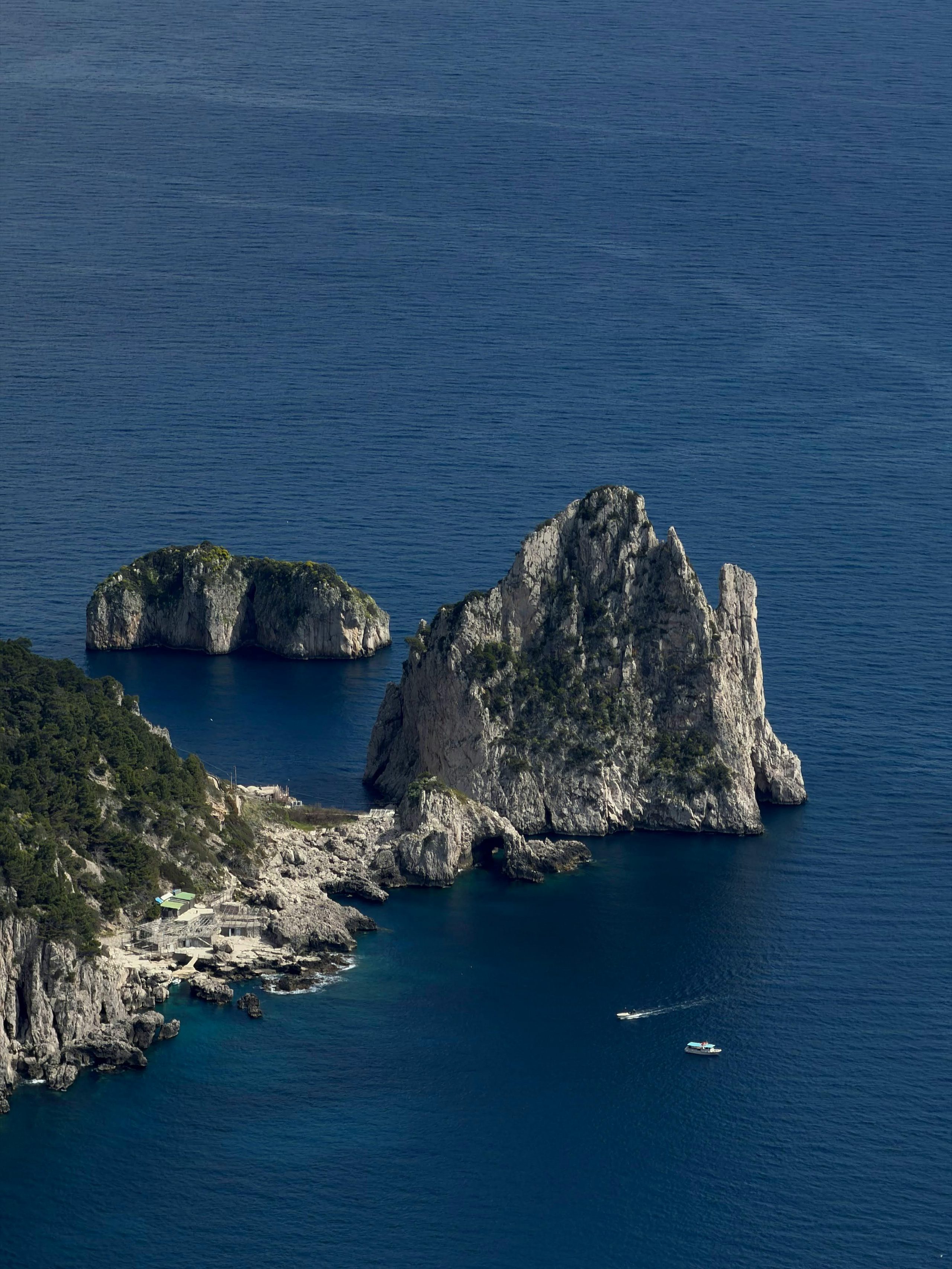
The Faraglioni are three magnificent rock formations rising from the sea in front of Marina Piccola. They are the most recognisable symbol of Capri, appearing in countless films, photographs and paintings. Each rock has a name: Faraglione di Terra (the largest, still connected to the coast), Faraglione di Mezzo (the most iconic, with a natural sea arch) and Faraglione di Fuori, also known as Scopolo.
Legend has it that these rocks are the remains of an ancient castle, but the geological truth is equally fascinating: they are remnants of ancient volcanic eruptions, shaped by the sea and wind over millions of years. A superb view of them can also be enjoyed from the terrace of Anacapri.
Three Rocks, Three Personalities
The dimensions of the Faraglioni are impressive up close: Faraglione di Terra (still connected to the shoreline) rises 109 metres. Faraglione di Mezzo, 82 metres tall, features the famous natural arch of around 40 metres through which boats pass. Faraglione di Fuori (or Scopolo), the furthest from shore, reaches 104 metres. Together they stretch for roughly 300 metres across the sea.
The arch tradition: when a boat passes through the archway of Faraglione di Mezzo, couples are said to kiss for good luck. Every island boat tour includes this ritual, to the applause of fellow passengers.
How to See Them at Their Best
From Marina Piccola
The classic view
The most photographed and dramatic panorama. Ideal at sunset.
Island Boat Tour
The full experience
Sail around the Faraglioni to see the sea arch from the water. Snorkelling possible.
From Punta Tragara
The panoramic view
From this headland you see the Faraglioni from a different and dramatic angle.
Night Illumination
A rare experience
In summer, lit up at night with a magical atmosphere. Best seen from Marina Piccola.
Stories & Curiosities
The arch of Faraglione di Mezzo: The natural sea arch is roughly 40 metres long and is one of the main attractions. Between legend and reality, the ancient Romans used this formation as a navigation landmark.
The Faraglioni in Cinema: They have appeared on screen in dozens of Hollywood and Italian films, including "La Dolce Vita" and "Only You". They are the single most recognisable Italian travel symbol in the world.
The Endemic Population: An endemic lizard lives on the Faraglioni - the blue lizard of Capri - found nowhere else on earth and protected by international law.
The Blue Lizard of Capri
On Faraglione di Fuori (Scopolo) lives one of the rarest reptile species in Europe: Podarcis sicula coerulea, the blue lizard of Capri. Its intense blue colour - so unlike the common green-brown lizard - evolved through isolation. With no land predators on the isolated rock, camouflage against vegetation was no longer needed; the blue colouration likely became established through sexual selection. It is protected by Italian law and can only be observed from boats approaching Faraglione di Fuori.
The British writer Norman Douglas, who spent many years on Capri, devoted memorable pages to the Faraglioni in his "Siren Land" (1911), describing them as "three fingers of rock pointing at the sky". Some scholars believe Homer himself was inspired by the Faraglioni for the rocks hurled by the Cyclops Polyphemus at Odysseus's ship.
Marine Life & Diving
At the base of the Faraglioni lie underwater caves accessible only to experienced divers. Visibility often reaches 30 metres, with seabeds rich in groupers, barracuda, moray eels and gorgonian sea fans. Diving centres on Capri organise guided dives in this area. For snorkellers, Marina Piccola offers good visibility near the shallower rocks.
The marine currents that form between the three rocks attract large quantities of plankton, which in turn draws bigger fish. Dolphins are not uncommon in the waters around the Faraglioni, especially at dawn or dusk.
109
m Faraglione di Terra
40
m middle arch
30+
m diving visibility
300
m total span
Local Tips
- For the best photographic light, go to Marina Piccola between 16:00 and 18:00: the Faraglioni glow gold in the afternoon sun.
- Book the boat trip directly at Marina Grande early in the morning, bypassing town agencies that charge a commission.
- The path to Punta Tragara is free and scenic: 20 minutes on foot from Capri town, with none of the crowds at the piazzetta.
- If you take the boat tour, specifically ask to pass under the arch of Faraglione di Mezzo - not all tours include it automatically.
- To spot the blue lizard, approach Faraglione di Fuori slowly by boat in the morning, when the lizards bask on the sun-warmed rocks.