
Sorrento · Sorrentine Peninsula
Bagni della Regina Giovanna
A natural pool among the ruins of a first-century Roman villa.
Sorrento's Natural Swimming Pool
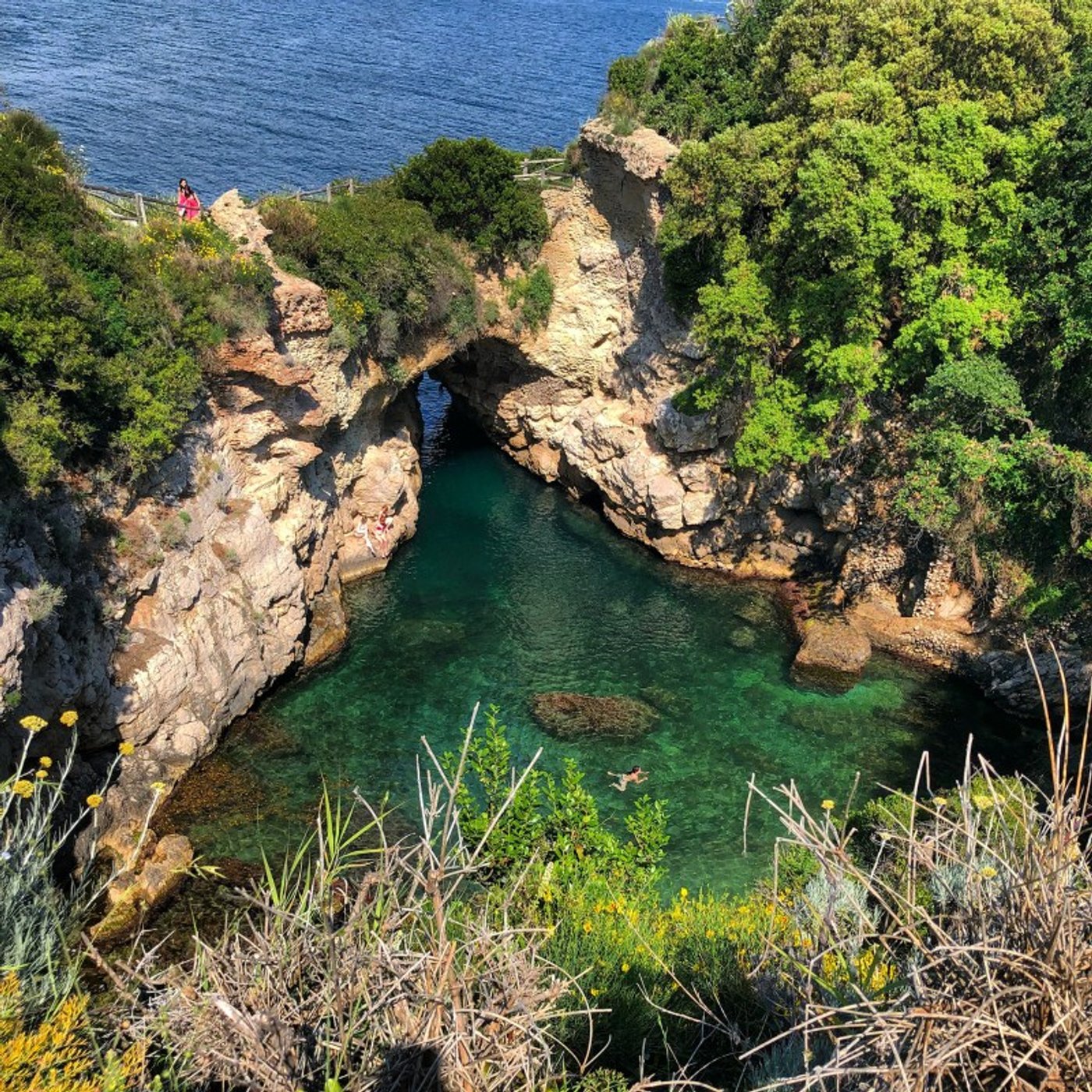
The Bagni della Regina Giovanna are the best-kept secret of Sorrento. A natural pool of emerald-green water, enclosed between limestone cliff walls and pierced by a natural rock arch that connects it to the open sea. All around, the remains of a 1st-century AD Roman maritime villa rise from the Mediterranean scrub like ghosts of a vanished world.
This is not a beach in the conventional sense: it is an archaeological and natural treasure box where you dive between ruins. No beach clubs, no bars, no lifeguards. You arrive on foot, along a 20-minute trail through ancient olive groves, and discover a place that the people of Sorrento have been coming to for generations - long before it became famous on social media.
The Villa of Pollio Felice: History and Archaeology
The ruins surrounding the natural pool belong to a 1st-century AD maritime villa attributed to the Roman nobleman Pollio Felice, a wealthy equestrian and arts patron. The villa is described in detail by the Latin poet Publius Papinius Statius in his Silvae (II, 2), where he celebrates it as one of the finest residences on the Gulf of Naples.
Statius's Description (1st century AD)
"The villa juts out towards the sea on a promontory where the land seems to dissolve into the water. The rooms open directly onto the Tyrrhenian and the waves lap the mosaics of the summer dining rooms."
Statius describes a residence with private baths fed by fresh water, a private harbour (the present natural pool, sheltered by the rock arch), terraced gardens with fruit trees and a system of cisterns for collecting rainwater - some of which are still visible among the vegetation.
The villa covered a much larger area than what is visible today. It extended along the whole of Punta del Capo, exploiting the natural shape of the headland to create a residence that blended architecture and landscape. The foundations, perimeter walls and cisterns are still recognisable among the olive trees and scrubland.
After the fall of the Roman Empire, the villa was gradually abandoned and nature reclaimed the structures. Natural collapses and marine erosion created the rock arch that is now the most spectacular feature of the site.
The Legend of Queen Giovanna
The name "Regina Giovanna" has nothing to do with the Roman villa. It refers to Joanna I of Anjou (1326-1382), Queen of Naples, one of the most controversial and fascinating figures in Italian medieval history.
According to local Sorrentine legend, the queen loved to retreat to this secluded spot to bathe away from prying eyes. The natural pool, sheltered by the rocks and invisible from the open sea, was the perfect refuge for a sovereign who wanted to escape the intrigues of the Neapolitan court.
Did you know?
1st c.
Age of the Roman villa
1382
Death of Joanna I of Anjou
20 min
Trail through the olive groves
The Natural Arch and the Pool
The most spectacular feature of the site is the limestone rock arch that separates the natural pool from the open sea. The arch, formed over millennia by marine erosion, was probably the entrance to the Roman villa's private harbour.
The pool is a basin roughly 30 metres in diameter, with turquoise crystal-clear water, 2 to 5 metres deep. The seabed is rock and sand, with abundant marine life visible to the naked eye: white seabream, wrasse, sea urchins and octopuses. Snorkelling here is exceptional, especially beneath the arch where the light creates dazzling reflections.
Entry into the water is from the flat rocks surrounding the pool. There is no sand: water shoes are essential. The more adventurous jump from the arch (about 3-4 metres high), but check the depth carefully first.
How to Get There
The Bagni della Regina Giovanna are at Punta del Capo, the western tip of the Sorrentine Peninsula. They cannot be reached by car: the final stretch is a pedestrian trail.
EAV Bus · Recommended
"Capo di Sorrento" line
From Piazza Tasso, alight at Capo di Sorrento. Then 15-20 min walk through the olive groves. The trail is signposted.
On foot from the centre
About 40 minutes
Follow Via del Capo towards Punta del Capo. Scenic but demanding uphill sections. Bring water.
By car
Via del Capo parking
Limited parking along Via del Capo. In summer it fills up early (arrive before 9:00). Then 15-20 min walk.
By sea
Kayak or private boat
You can enter the natural pool through the rock arch by kayak or dinghy. No rental services on site.
The Trail: From Capo di Sorrento to the Pool
Descent through the olive groves (10 min)
From the bus stop a dirt trail descends through centuries-old olive groves and dry-stone walls. The route is shaded and pleasant, with sudden views across the Gulf of Naples and the island of Capri.
The villa ruins (5 min)
The trail passes alongside the remains of Pollio Felice's villa: cisterns, perimeter walls and foundations emerge from the vegetation. Informational panels (often faded) explain the history of the site.
The final descent (5 min)
The last section is the steepest: you scramble down through the rocks to sea level. The rock arch appears suddenly, framing the turquoise pool. The visual impact is extraordinary.
Practical Tips
1. Bring everything with you
There are no bars, restaurants or facilities. Bring water (at least 1.5 litres per person), food, sunscreen, water shoes, a towel and a bag for your rubbish. The only bin is at the start of the trail.
2. Arrive early in summer
In July and August the pool fills up by 10:00, especially at weekends. Arriving at 8:30-9:00 guarantees space on the rocks and crystal-clear water before it gets disturbed by swimmers.
3. The best snorkelling is under the arch
The point where the rock arch meets the open sea teems with life: white seabream, damselfish, octopuses and sea urchins. Bring a mask and snorkel - this is the best free snorkelling on the Sorrentine Peninsula.
4. Sunset from the villa
If you stay until late afternoon, climb back up to the villa ruins for sunset: the golden light over the Gulf of Naples with Capri and Vesuvius in the background is one of the finest natural spectacles in the area.