
Massa Lubrense · Marine Protected Area · FAI
Baia di Ieranto
Among the world's 8 most beautiful bays: protected nature, Capri's Faraglioni and a sea where fish have no fear of people.
For the Adventurous Only
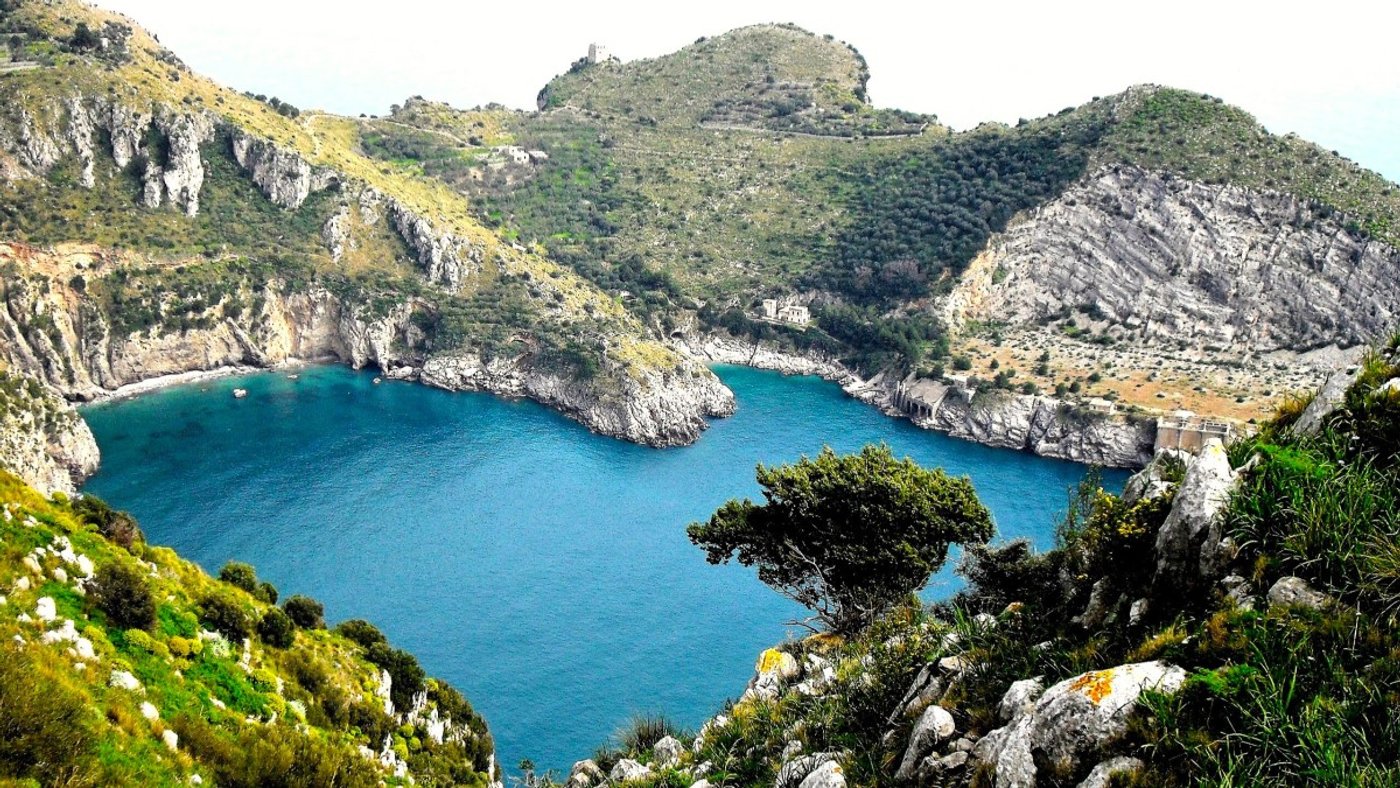
Ieranto is not a beach for everyone. There is no road, no facilities, no sunbeds. There is only a hiking trail of about 40-50 minutes that descends through a maritime pine forest to a hidden cove of golden sand and pebbles, surrounded by near-100-metre white cliffs.
If you are willing to do the hike, you will find what few tourists ever see: an almost deserted beach, crystal-clear water for snorkelling, and the sound of cicadas in the pine cones descending to the marine horizon. This is where the coast turns truly wild.
Protected by the FAI - Italian Environment Fund since 1987 and part of the Punta Campanella Marine Protected Area, this bay has been included in the list of the world's 8 most beautiful bays by several international travel publications. The reason is obvious the moment you arrive: a crescent set between cliffs, with the Faraglioni di Capri directly in front, so close they seem reachable by swimming. And the fish - protected by a no-fishing ban - swim centimetres from shore without a trace of fear.
Ieranto by the numbers
1987
Year of FAI acquisition
49 ha
Protected area
200+
Marine species recorded
Top 8
Most beautiful bays in the world
History: From Myth to Quarry to Rebirth
The name "Ieranto" derives from the ancient Greek Ieros (sacred). According to tradition, the headland was sacred to the Sirens of Greek mythology: it is right here, between Ieranto and Punta Campanella, that Odysseus - tied to the mast of his ship - heard the irresistible song of the Sirens on his return journey from Troy.
The Romans built a Temple of Athena (Minerva) on the nearby Punta Campanella, confirming the sacredness of the place. For centuries the bay remained the territory of fishermen and farmers, with the olive-terraced slopes that still mark the landscape today.
The Former Italsider Quarry (1918–1952)
In 1918 the Italsider company opened a dolomitic limestone quarry on the eastern side of the bay. For 34 years the quarry extracted stone from the cliff, loading it directly onto barges moored in the bay via a system of cable cars and hoppers. The activity radically transformed the landscape, leaving scars in the rock that are still visible today.
The quarry closed in 1952. The remains of the industrial plant - pylons, rails, hoppers - were gradually absorbed by the vegetation. In 1987 the FAI purchased the entire area (49 hectares) through a donation, launching an environmental recovery programme that has transformed an abandoned industrial site into one of Italy's most precious natural places.
Marine Protected Area: The Underwater Sanctuary
Baia di Ieranto falls within Zone B (general reserve) of the Punta Campanella Marine Protected Area, established in 1997. This means an absolute ban on fishing, collecting organisms, free anchoring and motor navigation. The result, after nearly 30 years of protection, is a marine ecosystem of extraordinary richness.
The waters of Ieranto have become a true natural laboratory demonstrating what happens when the sea is left in peace. Species that are rare or gone elsewhere thrive here just metres from shore.
What You See Snorkelling
Reef fish
Brown grouper, white seabream, damselfish
Brown grouper reach 50-60 cm and approach swimmers without fear. White seabream form shoals of dozens among the rocks. Blue damselfish colour the water like confetti.
Pelagic predators
Mediterranean barracuda, dentex, amberjack
Mediterranean barracuda (up to 1 metre) patrol the bay entrance in small groups. Dentex and amberjack are spotted in deeper water, especially early in the morning.
Seabed
Octopuses, moray eels, starfish, sea urchins
Octopuses are common among the rocks (don't touch them). Moray eels hide in crevices. The seabed is rich in sea urchins, anemones and colourful nudibranchs visible at just a few metres depth.
Posidonia meadows
The Mediterranean's key ecosystem
The Posidonia oceanica meadows covering the seabed are the habitat that sustains all this biodiversity. They produce oxygen, protect the coast from erosion and shelter hundreds of species.
The FAI Trail: From Nerano to the Bay
Departure from Nerano (0-10 min)
Start from the small square at Nerano (a hamlet of Massa Lubrense). The trail begins with a paved mule track between dry-stone walls and olive groves. FAI panels point the way. First glimpses of Marina del Cantone.
Through the Mediterranean scrub (10-25 min)
The trail enters Mediterranean scrub: myrtle, lentisk, wild rosemary and maritime pines. The air is wonderfully fragrant. The bay begins to appear in the distance and the Faraglioni di Capri emerge on the horizon.
The old quarry remains (25-35 min)
You pass through the remains of the former Italsider quarry: concrete pylons swallowed by vegetation, rusty old rails, hoppers. A piece of industrial archaeology that the FAI has chosen to preserve as a historical record.
Final descent and the bay (35-50 min)
The last section drops steeply to the sea. At one point the bay opens before you in full splendour: pale sand, turquoise water, white cliffs and the Faraglioni di Capri perfectly aligned on the horizon. The visual impact is unforgettable.
How to Get There
Hiking trail · Recommended
From Nerano (Massa Lubrense)
40-50 min downhill, 60-70 min uphill. FAI-signposted trail. Parking at Nerano (limited in summer, arrive early). Difficulty: moderate.
By sea
Taxi boat or kayak
Taxi boat from Marina del Cantone (~10 min, €50-80 per boat). Kayak hire from Marina del Cantone. Combustion engines banned in the bay (protected area).
Bus + hiking
From Sorrento to Nerano
SITA bus from Sorrento to Nerano (about 30 min). Then trail on foot. Car-free option. Check timetables at sitasudtrasporti.it.
By car
Parking at Nerano
Limited parking at Nerano (few roadside spaces). In summer arrive before 8:30. About 25 min from Sorrento by car via SP45.
5 Local Tips
1. Bring everything with you
There are no bars, restaurants or facilities of any kind. Bring water (at least 2 litres per person), food, sunscreen, a hat, closed shoes for the trail, water shoes for the water, a mask and snorkel. A bag for rubbish is essential: leave nothing behind.
2. Mask and snorkel are non-negotiable
Coming to Ieranto without a snorkel mask is like going to the Louvre blindfolded. Grouper approach to within a metre. Barracuda patrol the bay entrance. Posidonia meadows teem with life. This is the finest snorkelling on the Sorrentine Peninsula.
3. Leave early, return before 16:00
The return climb (60-70 min) in afternoon heat is brutal. Leave Nerano at 8:00-8:30, enjoy the bay until 14:00-15:00, and head back up in the late afternoon when the trail is in shade.
4. After the bay, lunch at Nerano
Nerano is famous for Spaghetti alla Nerano (fried courgettes and provolone del Monaco), invented here in 1952. After the hike, a plate at Taverna del Capitano or Maria Grazia is the perfect reward.
5. Respect the protected area
No fishing, no collecting shells, sea urchins or any organism. No anchoring on Posidonia meadows. Do not touch the fish (even if they come close). Respecting the rules is what makes this place so special.